Imperial Palace
His Property (A Dark Vampire High School Bully Romance) (Vampire Boy Swords): Prince of Londinium (Dead Sun: Prince of Londinium (A Dark High School Bully Romance) (Vampire Boy Swords) Book 1)The Emperor’s Palace is the principal royal setting in the underground city of Londinium and the stage for the novel’s decisive revelations about Clara Driscoll. In the twenty-sixth century, its Level One ballroom combines extravagant beauty with political danger: beneath moonlight and chandeliers, Clara learns that her life in 1987 was constructed around a concealed royal identity, while rival men treat her disputed inheritance as grounds for possession. The Palace therefore functions not merely as a residence, but as a ceremonial machine that converts ancestry, desire, and violence into public spectacle.
Setting and Appearance
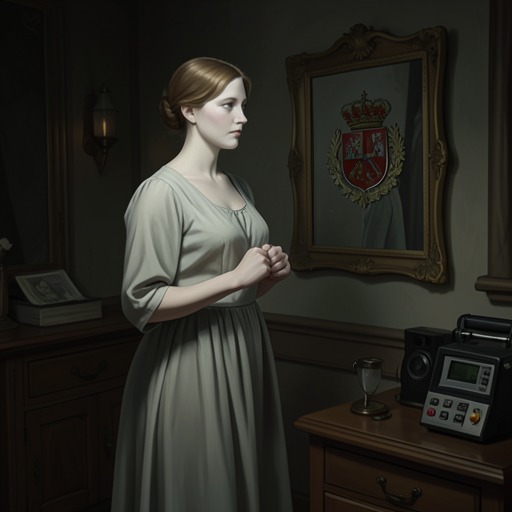
The Palace stands on Level One of Londinium, a vast underground city in the twenty-sixth century. The ball takes place on a wooden dance floor lit only by moonlight, within a ballroom as large as a football field. Tall mirrored panels line the room, gold statues hold burning candles at intervals, crystal chandeliers hang from a domed ceiling, and vibrant frescoes depict figures from Greek mythology in various states of undress. The architecture joins royal grandeur to a controlled subterranean world, making the Palace both dazzling and enclosed.
The ballroom’s elaborate eighteenth-century styling intensifies that contradiction. Ladies wear gothic ball dresses, while men appear in long black embroidered tail coats and waistcoats. The historical costume does not restore the past; it stages a curated version of it inside a futuristic society whose inhabitants include vampires, werewolves, and other evolved beings. The Palace consequently presents history as ornament even while buried historical conflicts return through Clara’s body and identity.
Clara’s Revelation in the Ballroom
During the ball, Lord Byron Phraeon leads Clara around the dance floor while she absorbs the revelation that she is the child of the lost Empress. She understands that she was somehow stolen and hidden in 1987, centuries before Londinium existed, and that the identity she had lived under was false. The discovery makes her question her mother, James Driscoll’s relationship to her, and the hostility she had experienced from the man she believed to be her father. Her memories become painful evidence of a life built on concealment.
The Palace makes that private crisis public. Clara tries to pull away from Byron, but he sharply draws her back and holds her tightly enough to leave her unable to breathe. Her eyes fill with angry, hurt tears, and she is distressed not only by the revelation but by the fact that everyone can see her losing control. When she asks him to let her go, he answers with soothing language about the past and the future while continuing to treat her distress as something he can manage. The contrast between ceremonial politeness and physical restraint gives the ballroom’s elegance an unmistakably coercive edge.
The audience around them magnifies the humiliation. Louise Turner and Terri watch while dancing, Prince Octavius appears taken aback, and Darius Constantine’s expression darkens as he glares at Byron as though prepared to kill him. The entire ballroom turns toward the spectacle. Clara looks past the crowd to the chandeliers and mythological frescoes, hoping her tears will recede, but the Palace offers no private refuge within its public grandeur.
Courtship, Rivalry, and Royal History
When Byron declares that he has staked his claim to Clara under the rule of courtship, the Palace becomes the arena in which an ancient social system is asserted against Clara’s objections. He presents a kiss on the cheek as a meaningful claim, while Clara rejects the idea that such a gesture can make her an object to be owned. Darius Constantine counters that the ancient Taleian bonding ritual, even in the muted form used by Byron, has not been properly initiated. Their argument turns Clara into the contested center of a male rivalry, although she explicitly objects to being discussed as though she were absent.
The Palace also houses the historical explanation that gives this conflict its larger significance. Prince Octavius recounts that, in ancient Briton before the Roman invasion, the Britons were divided between the Druids and the Taleians. The Taleians possessed distinctive gifts: their men were powerful warriors and expert swordsmen, while their women possessed extraordinary psychic abilities. Their clans were governed by Queen Morrigan of the first royal clan, whose consort and Knight of Swords came from the Breannin Clan, the second royal clan.
According to Octavius, the Book of Talus selected a Taleian’s mate by causing the child’s name and the name of a designated fated mate to appear together at birth. The bonding ritual survived from ancient Briton but had been weakened by the Emperor. In the Palace’s courtly setting, this history explains why a gesture that Clara experiences as a kiss or an unwanted claim carries institutional weight for the Taleians, and why the men around her interpret attraction as a duty to compete.
Octavius further reveals that the Queen and Knight of Swords were murdered by the Druids while attempting to help their people with the aid of the Magician, the Queen’s powerful magical adviser. A later Queen was not born until 1893, and she was the child of a Taleian male and a human female. Because Taleians could no longer reproduce among themselves, Taleian men formed relationships with human women and produced hybrids. These children did not assume their true Taleian vampire form until later in life or until their bodies were ready; awakening involved a small death, after which they appeared no older than twenty-five.
The history becomes explicitly dynastic when Octavius says that the Empress possessed the DNA strands of all their people and ruled wisely with the Five Princes. The Book of Talus supplied mates and advisers who guarded her power and kept her safe. He claims that the Emperor, driven by cruelty and jealousy, found a way to murder the Empress, her child, and the Princes. In this account, the Palace is not simply the seat of the current ruler. It is the architectural center of a regime built over a royal massacre and a suppressed alternative order.
Public Space, Private Resistance, and Disruption
Clara attempts to leave the dance floor by lifting the skirt of her black silk dress and seeking somewhere quiet to think about her heritage. Louise Turner notices her distress, asks whether she is all right, and leaves Terri to come to her aid. As Louise offers to talk, Darius and Byron remain behind arguing. The Palace thus produces two competing forms of response: men dispute the right to possess Clara, while Louise recognizes the immediate emotional reality of the woman at the center of the dispute.
The conflict later intensifies around the question of protection. Octavius insists that Clara must accept his involvement because he is a skilled swordsman and must protect her from challengers. Clara answers that she has lost her home and does not belong in Londinium, in the twenty-sixth century, or to anyone there. Octavius nevertheless tells her that she belongs to him and that he will protect her. Within the Palace, the language of protection repeatedly overlaps with confinement, making royal guardianship inseparable from claimed ownership.
The confrontation does not resolve through conversation. Clara declares that she is not going with any of the men, but Darius still refuses to release her. Prince Octavius is ready for a fight, and the rules require the challengers to wait. Carter approaches and calmly asks Clara whether she needs him to come and get her, offering a striking contrast to the possessive claims surrounding her. Before the conflict can become a duel, the ground shakes violently. A second tremor threatens to throw everyone off balance, followed by a flash of blue light and a loud bang that hurls the occupants into the air and leaves them unconscious.
The Palace’s final transformation is therefore abrupt and physical. The ballroom begins as a place of dance, costume, and royal display; it becomes a courtroom for competing claims, a classroom for forbidden history, and finally the site of a shock that interrupts the promised fight. The blue-light explosion leaves the conflict unresolved and closes the book on a cliffhanger, with the Palace itself converted from a symbol of controlled order into the scene of its collapse.
Narrative Significance
The Emperor’s Palace concentrates the novel’s central tensions: the future is built beneath the ground yet governed through revived ancient rituals; aristocratic beauty conceals historical violence; and protection is offered in forms that threaten Clara’s autonomy. Its mirrors and statues make every gesture visible, while its subterranean location suggests that the past has not disappeared but has been buried beneath the civilization that claims to supersede it.
Most importantly, the Palace turns Clara’s identity into a political event. Her arrival from 1987, her connection to the murdered Empress, and the competing claims of Byron, Darius, and Octavius all converge in one public space. The setting forces concealed history into view while denying Clara the privacy needed to process it. By ending with the Palace shaking and its inhabitants unconscious, the narrative leaves both its succession crisis and its courtship conflict suspended, promising that the royal building will remain the central pressure chamber of the continuing story.